
Computer Cartoons by Bob Stevens
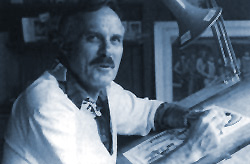
Bob Stevens, Cartoonist
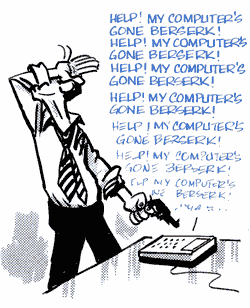
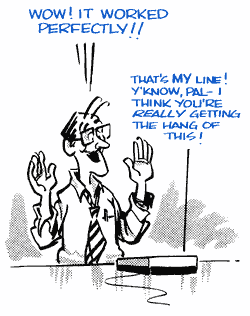
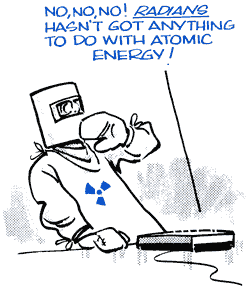
If it were possible to make CompuSoft books more fun, they would include cartoons by Bob Stevens. And that’s just what we did. Below are only a few single-panel illustrations readers enjoyed about every five pages. Stevens’ caricatures depicted him as the bumbling BASIC programmer, with occasional supporting characters resembling our dear Dr. Lien.
Chuck Yeager, a 25-year fan of Stevens’ work in Air Force Magazine, said, “Any guy who can make something humorous out of a gear-up landing has my vote as a first class cartoonist.”
I met Bob Stevens in my first year at CompuSoft. He died in 1994 at the age of 71 after battling cancer.
 |
 |
 |
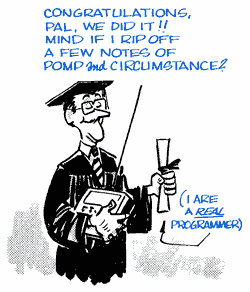 |
Who’s Afraid of Perl?

1997 (unpublished)
Academic Press asked me to write Who’s Afraid of Perl? as part of their series of programming books. After completing the front and back matter, chapter outline, sample chapters and programs, my editor unexpectedly left the company. Inquiries into the fate of the book went unanswered for months. However, things were picking up at CTSnet, so I didn’t pursue the publisher about it. Oddly, this book was listed on Amazon. (Maybe it should be called Who’s Afraid to Publish a Perl Book?)
Published 1996
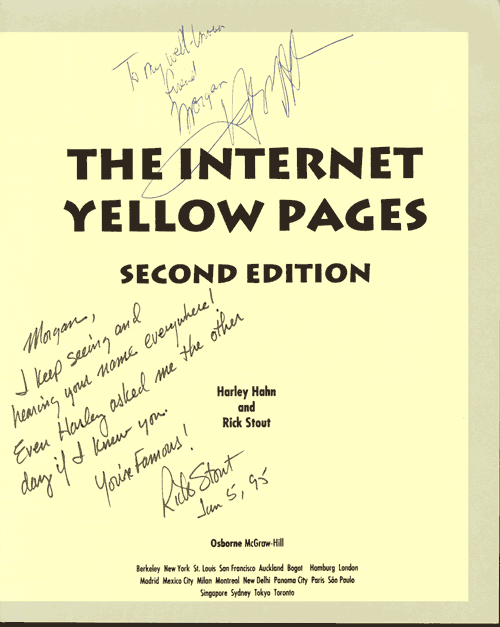
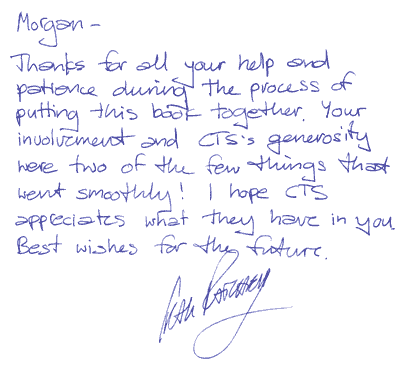
[ with co-author Rick Stout. ] The concept is deceptively simple: find a science or technology web site, learn all about it, and write a pithy description. Repeat that process hundreds and hundreds of times… and you have the makings of a major writing chore. To keep our sanity while producing a fun and functional sci-tech site catalog, it demanded outrageous and funny departures. Despite more work than expected, I had a great time writing with Rick Stout. Check out my IYP:SRT web site for more details. Among many other books, Rick also wrote the original Internet Yellow Pages with Harley Hahn. Here’s a signed inscription from a copy they presented to me. (blush)
Published 1988
[ with co-author Dan Gookin. ] This was the more technical follow-up to the original Apple IIGS programming book Dan and I wrote the year before. Though it had fewer pages, it was more challenging to write as it included C, Pascal, and 65816 assembler code for every example.
Mastering the Apple IIGS Toolbox
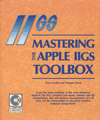
Published 1987
[ with co-author Dan Gookin. ] This 642-page monster reveals the secrets to programming the Apple IIGS, Apple’s last incarnation of the Apple II series. The IIGS combined the value of the venerable Apple II with the user-friendliness of the Mac. The GS stands for graphics and sound, cutting edge at the time, rivaling that of its Mac brethren for a while. (Trivia: The publisher sorted our hexadecimal toolbox function index in alphabetical order, making it a treat for programmers to follow.)
CGI / Perl Cookbook
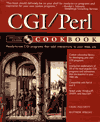
Published 1998
[ Assisted author Craig Patchett. ] While at CTSnet, I had the opportunity to assist other writers, such as Craig Patchett. Craig kindly thanked me with this personalized inscription and acknowledgment: “Morgan Davis at CTSNET was generous enough to offer a free account for the development of the book’s programs in addition to answering a wide array of technical questions … deserving not only our gratitude but a hearty endorsement if you’re looking for a service provider.”

Published 1997
[ Technical Editor for author Rick Stout. ] After finishing the Internet Yellow Pages book with Rick, we teamed up again, only this time I took the role as tech editor for this excellent book. Rick shows how to squeeze valuable information from web server logs so you can learn about visitor traffic and tune your site effectively. It subsequently became the focus of a magazine article in which I was interviewed for a side-bar column in NetGuide Magazine.
MouseTalk
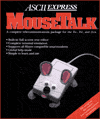
Published 1987
[ Technical Editor / Programmer. ] I did more programming than writing for the updated MouseTalk manual, and offered plenty of literary tech support. MouseTalk, from United Software Industries, Inc., was a user-friendly terminal program for the Apple II series. It employed mouse technology with unique on-screen pull down menus and dialog boxes. Although it was the easiest modem application at the time, it was built on the powerful ASCII Express Pro framework, creating a robust telecommunications tool for its day.
ASCII Express Pro for MS-DOS
Published 1984
[ Technical Writer / Product Tester. ] Writing and editing portions of the ASCII Express Pro for MS-DOS manual was my first opportunity to work with Bill Blue and United Software Industries. To help document his next terminal program, Bill enlisted enthusiastic members of his bulletin board system who knew modem communications well and could write. Among us were Ryan Gale, Irwin Hom, and Joe Holt (who also was one of the programmers). We worked out of Bill’s converted garage on a Compaq Portable (which was more luggable than portable).
CompuSoft Publishing

Technical Researcher and Writer
I joined CompuSoft Publishing as a technical researcher and writer directly out of high school — my official entry into a career in computers. It was a tremendous experience that gave me exposure to many different types of personal computers: TRS-80 series, Timex Sinclair, Kaypro, Osborne, Apple II, Macintosh, IBM PC, and all their operating systems, including XENIX.
CompuSoft’s prime focus was adapting a successful manuscript on learning BASIC programming for various computers. The original BASIC book was written by Dr. David A. Lien, a microcomputer industry pioneer and best-selling technical author. Lien’s friendly style makes learning BASIC fast and fun. Several books are illustrated with hilarious cartoons by renowned aviation cartoonist, Bob Stevens.
Along the way, I introduced online BBS pal, Dan Gookin, to CompuSoft. That initiated his extremely successful career in writing, and our subsequent Apple IIGS book collaborations.
In addition to working with a great group of people, the most valuable aspect was understanding and appreciating the superbly unique, non-threatening writing style of Dr. Lien. Below are just some of the CompuSoft titles I had the privilege to work on.